
Thickness 0.1 - 0,2 mm
High Resin Coating
A resistant, seamless, and ideal solution for floors that require greater protection and durability.
Resistance
The thick resin film offers superior protection compared to thin treatments. Ideal for floors subjected to frequent traffic and light to medium stress.
1
Protection
Create a continuous barrier against liquids, oils, and chemical agents. Reduces wear on concrete and simplifies daily cleaning.
2
Continuity
Uniform surface, without joints or discontinuities. Improves the aesthetics of the floor and ensures greater hygiene and durability.
3
What is Thick Resin Film
The thick film is a resinous system that is applied to the floor with a more substantial thickness compared to light surface treatments. This type of coating is designed to ensure greater mechanical resistance, more effective protection, and a continuous surface capable of withstanding more demanding usage conditions.
Unlike the thin film — which is designed to uniform and protect the concrete without significantly increasing its thickness — the thick resin creates a true technical layer capable of strengthening the flooring and improving its performance in terms of durability, safety, and cleanability.
Request more information or a quote
RPM Italia provides thick film treatments for industrial, commercial, and technical environments. Contact us for a personalized consultation or to schedule a site visit.
Practical differences
Why choose a high-thickness resin floor
The thick film represents an excellent compromise between lighter resin systems and high thickness cycles such as multilayer or self-leveling. It offers a higher level of protection while maintaining a relatively quick and non-invasive installation.
Thanks to the thicker layer, this treatment is ideal in environments that require a more robust surface compared to a simple protective film. It can withstand frequent traffic, movement of carts and light equipment, reducing wear on the concrete over time while simultaneously creating an effective barrier against the absorption of oils, water, detergents, and chemicals.
Where thick film is used
Thanks to its characteristics, the thick film finds application in a wide range of contexts. In the industrial field, it is particularly suitable for warehouses, laboratories, workshops, assembly areas, and light production departments, where a higher level of protection is required but not necessarily a high thickness coating.
In the commercial sector, it is used in stores, showrooms, and public spaces, where a durable and well-finished floor contributes to the quality of the environment. Even in logistics, the thick film represents a valid solution for corridors and transit areas subject to frequent but not extreme use.
How the thick film is laid.
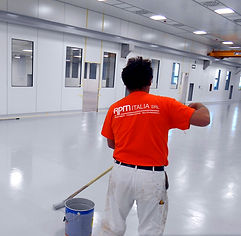
The application process begins with the mechanical preparation of the substrate, an essential phase to ensure perfect adhesion. The floor is cleaned, sanded, or polished to remove inconsistent parts and create the necessary roughness for the material to adhere.
Subsequently, a specific primer is applied, which consolidates the cement and prepares the surface for the application of the resin. The thick film is then applied with a roller or spatula in one or more layers, until the desired thickness is reached.
The result is a compact, uniform, and durable coating, ready to withstand daily use and preserve the floor over time.
Preliminary analysis of the environment
Every project starts with a technical inspection during which the existing support, environmental conditions, and usage methods of the floor are analyzed to identify the most suitable resin system and to prevent future issues.
1)

Preparation of the substrate
Targeted mechanical processing, such as sanding, grinding, and shot blasting, is carried out to prepare the concrete substrate, or other types, essential to ensure the adhesion of the resin cycle and the durability of the flooring.
2)

Execution of complementary works
Before or during the installation of the resin floor, complementary works are carried out, namely drainage supports, perimeter edges, and skirting boards. These elements help complete the environment and facilitate cleaning and sanitization.
3)
Application of the resin cycle
Based on the required performance, the installation of the resin floor is carried out following specific cycles. We calibrate thicknesses, finishes, and slip resistance to achieve a continuous, safe, and durable surface.
4)

Final inspection and commissioning
Once the hardening cycle is complete, and thus the catalysis of the product, the surface is ready to be used. At the end of the application, the floor is checked in every detail to ensure safety, continuity, and compliance with the project.
5)
Certifications and technical documentation
6)
At the end of the work, RPM Italia provides the client with the technical documentation related to the applied system, including the certifications required for each sector, to support the needs for monitoring and managing the flooring over time.

Alcune realizzazioni in resina di RPM Italia
Scorri la gallery e scopri alcune esempi di realizzazioni di RPM Italia.


