
Thickness 0,2 mm - 0,6 mm
Multilayer Resin Flooring
A robust, non-slip, and highly resistant system, ideal for industrial and production environments that require high performance.
Robustness
The multilayer system creates a highly resistant resin-mineral structure. Designed to withstand heavy loads, continuous traffic, and intense stress.
1
Safety
The anti-slip finish is adjustable based on the environment and the level of risk. Ideal for production departments, wet areas, and places where safety is a priority.
2
Durability
It resists wear, chemical agents, and abrasion over time. It protects the concrete and ensures high performance even in harsh conditions.
3
What is the Multilayer resin system?
The multilayer is a resinous cycle composed of several successive layers of resin and mineral aggregates (generally quartz), designed to create a durable floor capable of withstanding heavy usage conditions. Unlike simpler coatings, the multilayer builds a true structure, significantly improving mechanical resistance, durability, and surface safety.
This system allows for a very effective anti-slip finish, adjustable according to the needs of the sector and the type of expected traffic. It is one of the most widely used coatings in modern industry due to its combination of robustness, functionality, and long-term stability.
Request a quote or technical consultation
RPM Italia produces multilayer resin floors for industries, logistics, and professional environments. Contact us to receive a site inspection or to evaluate the most suitable cycle for your needs.
Practical differences
Why choose a multilayer floor
The multilayer represents the ideal solution when a floor needs to withstand constant stress, impacts, heavy loads, and continuous passage of vehicles and personnel. It can also be installed where there is no concrete, but tiles or other materials; the multilayer floor is perfect for areas where forklifts, lift trucks, or heavy machinery are used, as it does not deteriorate quickly and maintains its integrity over time.
Where the multilayer system is used
The versatility and robustness of the multilayer make this system widely used in manufacturing industries, mechanical departments, logistics warehouses, workshops, chemical fields, and storage areas. It is the standard solution for flooring subjected to heavy and repeated traffic.
It is also applied in the food sector, especially in preparation, processing, or washing areas where slip resistance and ease of cleaning are essential elements. Similarly, it is used in commercial and technical contexts, such as garages, transit corridors, and spaces that require a solid and continuous surface.
How to create a multilayer floor
The installation of the multilayer requires a process composed of several phases, all essential to ensure a lasting result. It starts with the preparation of the substrate through sanding, smoothing, or shot blasting, which is fundamental to eliminate inconsistent parts and promote the adhesion of the resin.
Subsequently, the primer is applied, and the first resin layer is spread, on which quartz is distributed in saturation. Once hardened, the surface is sanded, and additional layers of resin are applied until the desired finish is achieved, which can be more or less rough depending on operational needs. The result is an extremely stable, resistant, and structured floor, capable of maintaining high performance over time.
Preliminary analysis of the environment
Every project starts with a technical inspection during which the existing support, environmental conditions, and usage methods of the floor are analyzed to identify the most suitable resin system and to prevent future issues.
1)

Preparation of the substrate
Targeted mechanical processing, such as sanding, grinding, and shot blasting, is carried out to prepare the concrete substrate, or other types, essential to ensure the adhesion of the resin cycle and the durability of the flooring.
2)

Execution of complementary works
Before or during the installation of the resin floor, complementary works are carried out, namely drainage supports, perimeter edges, and skirting boards. These elements help complete the environment and facilitate cleaning and sanitization.
3)
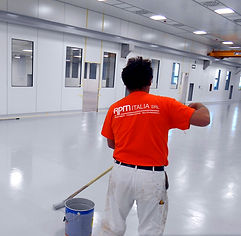
Application of the resin cycle
Based on the required performance, the installation of the resin floor is carried out following specific cycles. We calibrate thicknesses, finishes, and slip resistance to achieve a continuous, safe, and durable surface.
4)

Final inspection and commissioning
Once the hardening cycle is complete, and thus the catalysis of the product, the surface is ready to be used. At the end of the application, the floor is checked in every detail to ensure safety, continuity, and compliance with the project.
5)
Certifications and technical documentation
6)
At the end of the work, RPM Italia provides the client with the technical documentation related to the applied system, including the certifications required for each sector, to support the needs for monitoring and managing the flooring over time.

Alcune realizzazioni in resina di RPM Italia
Scorri la gallery e scopri alcune esempi di realizzazioni di RPM Italia.


