
Thickness 0.05 - 0,1 mm
Low thickness resin coating
A lightweight, functional, and cost-effective solution to enhance the protection and cleanliness of concrete floors.
The aesthetics
The low-thickness resin improves the surface, protecting the concrete and making it more durable.
1
Efficiency
Without invasive and especially expensive interventions, low-thickness resin improves the floor, making it neat, hygienic, and protected.
2
The cleaning
With a few treatment steps, the surface becomes easier to clean and easier to maintain over time.
3
What is the Thin Resin Film?
The thin film is a resin-based surface treatment that is applied to the floor in a very light layer. It is a system designed to uniform, protect, and make maintenance of concrete easier, without altering its structure and without creating a true high-thickness resin floor.
Unlike thicker systems, the thin film is applied in a few steps and creates a protective film that enhances the appearance of the surface, reduces liquid absorption, and facilitates daily cleaning.
Request a consultation or a quote
RPM Italia offers professional thin film treatments for industrial, commercial, and residential environments. Contact us for an inspection or to evaluate together the most suitable solution for your floor.
Practical differences
Superficie in resina a basso spessore realizzata da RPM Italia
Why choose a thin film treatment
The thin film represents an excellent solution for those who wish to improve their floor without undergoing invasive and especially costly interventions. The treatment allows for a neater, more hygienic, and homogeneous surface, making the environment more pleasant and functional. One of the main advantages of the thin film is its ability to give the floor a more uniform and well-kept appearance. Without intervening on the thicknesses or the structure of the substrate, the resin enhances the color of the concrete and improves its visual performance. The resinous film seals micro-pores and irregularities of the concrete, preventing dirt and liquids from being absorbed. The surface becomes much easier to wash and maintain over time.
Where is the thin film used?
The thin film is an extremely versatile solution suitable for numerous contexts. In the industrial sector, it is often used in technical rooms, light warehouses, service areas, laboratories, logistics corridors, and passage areas where high resistance of more complex systems is not required or where concrete has just been laid and needs protection without incurring excessively high costs.
In the commercial sector, it is used in stores, showrooms, exhibition spaces, and offices, where the aesthetics of the floor play an important role and where a clean and continuous finish helps enhance the environment.
How the thin film coating is applied
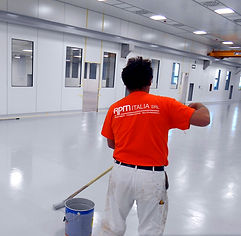
The application process begins with a deep cleaning and preparation of the concrete, necessary to ensure optimal adhesion of the product. In some cases, a specific primer is applied, after which the resin is rolled out in a very light and uniform layer. The resin film dries quickly and allows for a homogeneous surface without significantly altering the thickness of the floor. The installation is minimally invasive and requires reduced time, a feature appreciated in already operational environments.
Preliminary analysis of the environment
Every project starts with a technical inspection during which the existing support, environmental conditions, and usage methods of the floor are analyzed to identify the most suitable resin system and to prevent future issues.
1)

Preparation of the substrate
Targeted mechanical processing, such as sanding, grinding, and shot blasting, is carried out to prepare the concrete substrate, or other types, essential to ensure the adhesion of the resin cycle and the durability of the flooring.
2)

Execution of complementary works
Before or during the installation of the resin floor, complementary works are carried out, namely drainage supports, perimeter edges, and skirting boards. These elements help complete the environment and facilitate cleaning and sanitization.
3)
Application of the resin cycle
Based on the required performance, the installation of the resin floor is carried out following specific cycles. We calibrate thicknesses, finishes, and slip resistance to achieve a continuous, safe, and durable surface.
4)

Final inspection and commissioning
Once the hardening cycle is complete, and thus the catalysis of the product, the surface is ready to be used. At the end of the application, the floor is checked in every detail to ensure safety, continuity, and compliance with the project.
5)
Certifications and technical documentation
6)
At the end of the work, RPM Italia provides the client with the technical documentation related to the applied system, including the certifications required for each sector, to support the needs for monitoring and managing the flooring over time.

Alcune realizzazioni in resina di RPM Italia
Scorri la gallery e scopri alcune esempi di realizzazioni di RPM Italia.


