
Thickness 0,3 mm - 0,7 mm
Self-Leveling Resin Flooring
A continuous, smooth surface with high aesthetic value, designed to ensure durability, hygiene, and maximum cleanability.
Aesthetics
The self-leveling finish creates a smooth, uniform surface with high visual value. Ideal for professional environments that require order, brightness, and modern design.
1
Hygiene
Continuous and joint-free surface, easy to clean and sanitize. Reduces the accumulation of dirt and bacteria, ensuring high hygiene standards.
2
Resistance
High mechanical and chemical resistance despite the smooth finish. Suitable for frequent traffic, trolleys, and intensive use in industrial environments.
3
What is a self-leveling resin floor?
The self-leveling compound is a resinous system that, thanks to its particular formulation, distributes evenly creating a perfectly smooth, compact surface free of irregularities. Unlike thinner coatings or multi-layer cycles, the self-leveling compound forms a true continuous layer that enhances both the aesthetic appearance and the technical performance of the floor.
This type of flooring has the ability to self-level during application, eliminating micro-depressions and imperfections in the substrate and ensuring a uniform and professional result. It is one of the most appreciated solutions in modern medical companies, in healthcare environments, and in commercial spaces that seek an impeccable, easy-to-maintain, and aesthetically pleasing surface.
Request a consultation or a quote
RPM Italia creates self-leveling resin floors for industries, laboratories, food environments, and professional spaces. Contact us for a technical assessment or to schedule a site visit.
Practical differences
Why choose a self-leveling floor
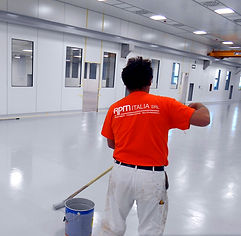
One of the main strengths of self-leveling resin flooring is its ability to create a perfectly smooth, continuous surface free of joints or unevenness, which helps make environments tidier, brighter, and more professional, as well as significantly facilitating cleaning operations.
Despite the uniform finish, the self-leveling resin ensures high mechanical and chemical resistance, making it suitable to withstand wear, loads, the passage of forklifts or carts, and contact with aggressive substances, characteristics that make it ideal for production departments, laboratories, and warehouses.
The continuous surface also limits the accumulation of dirt and bacteria in critical points, ensuring high standards of hygiene and sanitizability, which is why this system is widely used in the food, pharmaceutical, industrial kitchens, and healthcare sectors.
Where is the resin self-leveling used?
Self-leveling is one of the most versatile systems in the industry and finds application in numerous professional contexts. In industries, it is perfect for production lines, assembly areas, technical departments, and warehouses, ensuring a durable and reliable flooring.
In the healthcare and pharmaceutical sectors, it is highly appreciated for its compact and easy-to-sanitize surface, while in the commercial field, it is chosen for its modern, continuous, and customizable aesthetics. Many showrooms and offices also lean towards self-leveling due to the possibility of achieving glossy, matte, or colored finishes.
How the installation of self-leveling flooring takes place
The realization of the self-leveling compound requires careful preparation of the substrate. It starts with the grinding or shot blasting of the concrete, operations that eliminate inconsistent residues and create the necessary roughness for perfect adhesion. Once the primer is applied, the self-leveling product is spread over the surface and allowed to flow naturally.
During curing, the material stabilizes, forming a uniform and continuous layer. Depending on the needs of the environment, it is possible to create smooth, colored, satin, or high-gloss finishes. The result is a durable, elegant floor designed to last over time.
Preliminary analysis of the environment
Every project starts with a technical inspection during which the existing support, environmental conditions, and usage methods of the floor are analyzed to identify the most suitable resin system and to prevent future issues.
1)

Preparation of the substrate
Targeted mechanical processing, such as sanding, grinding, and shot blasting, is carried out to prepare the concrete substrate, or other types, essential to ensure the adhesion of the resin cycle and the durability of the flooring.
2)

Execution of complementary works
Before or during the installation of the resin floor, complementary works are carried out, namely drainage supports, perimeter edges, and skirting boards. These elements help complete the environment and facilitate cleaning and sanitization.
3)
Application of the resin cycle
Based on the required performance, the installation of the resin floor is carried out following specific cycles. We calibrate thicknesses, finishes, and slip resistance to achieve a continuous, safe, and durable surface.
4)

Final inspection and commissioning
Once the hardening cycle is complete, and thus the catalysis of the product, the surface is ready to be used. At the end of the application, the floor is checked in every detail to ensure safety, continuity, and compliance with the project.
5)
Certifications and technical documentation
6)
At the end of the work, RPM Italia provides the client with the technical documentation related to the applied system, including the certifications required for each sector, to support the needs for monitoring and managing the flooring over time.

Alcune realizzazioni in resina di RPM Italia
Scorri la gallery e scopri alcune esempi di realizzazioni di RPM Italia.


