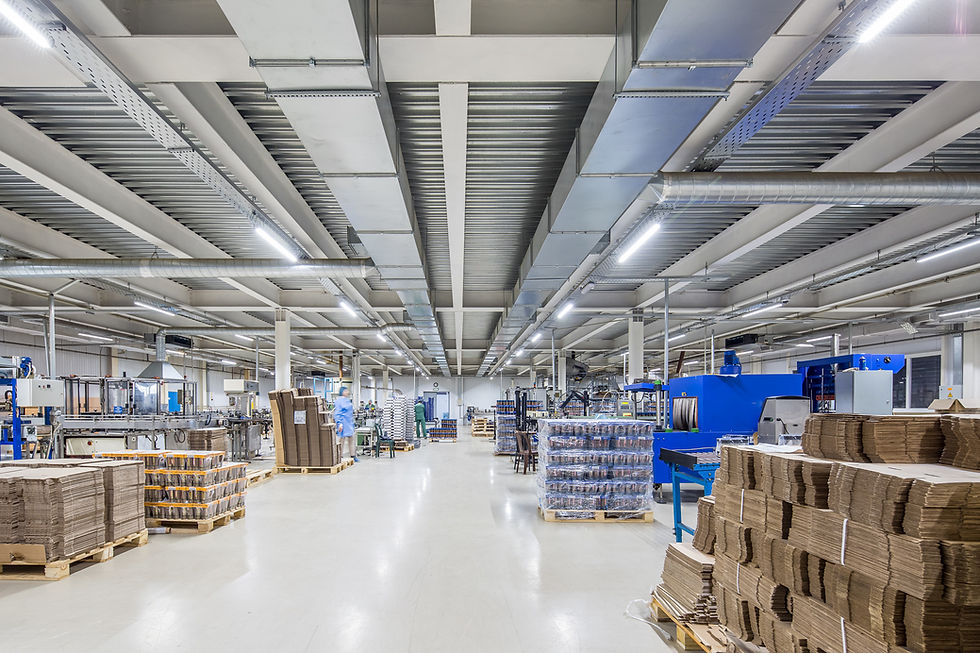
Thickness 0,05 mm - 1 cm
Polyurethane Resin Flooring
A flexible, durable coating that is ideal for environments that require hygiene, elasticity, and tolerance to thermal fluctuations.
Elasticity
The high performance of polyurethane resin generates a continuous and elastic surface, perfect for flooring subjected to vibrations and micro-movements.
1
Resistance
The polyurethane system has excellent chemical resistance capabilities, is durable, waterproof, and maintains good flexibility over time.
2
Safety
Due to its ease of management and long-lasting protection, polyurethane resin is the flooring choice for professional and production contexts.
3
What is Polyurethane Resin and what are its characteristics?
Polyurethane resin is a high-performance material that, once applied, generates a continuous and elastic surface, capable of adapting to the natural movements of the substrate. This feature distinguishes it from more rigid resins, making it perfect for flooring subjected to vibrations, thermal shocks, or micro-movements of concrete. It is also the suitable resin for expansion joints.
The polyurethane system offers excellent chemical resistance, impermeability, and durability, while maintaining good flexibility. This combination of properties makes it a widely used coating in professional and production contexts, where the environment requires protected, safe, and easy-to-manage surfaces.
Request a site visit or a quote
RPM Italia creates customized polyurethane resin flooring for industrial, food, and professional environments. Contact us to receive technical advice or to schedule a site visit.
H3 – The difference between dust-proof, epoxy, and polyurethane resin
The dust-proof resin is designed as a surface solution, intended to protect concrete without altering its structure or thickness. It serves as the base for other resin floors, such as those made of epoxy or polyurethane.
Epoxy is chosen for a durable and structured coating, capable of withstanding mechanical wear, heavy traffic, and chemical products. Polyurethane resin (or Poliuretano Cemento) is more elastic and resistant to thermal shocks and UV rays, making it ideal for food areas or environments subject to humidity.
The dust-proof resin does not replace these systems, but represents a lighter treatment, perfect when the main requirement is to block dust, improve cleanliness, and maintain the natural aesthetics of the concrete.
Practical differences
Epoxy resin
For a durable, compact, and joint-free floor, choose the epoxy resin from RPM Italy. Enhance the aesthetics, hygiene, and functionality of your surface.
The dustproof resin
The ideal solution to protect and consolidate concrete without altering its structure and thickness. Perfect for eliminating dust and improving the cleanliness of surfaces.
Why choose a polyurethane resin floor
Polyurethane resin is recognized for its ability to ensure high performance in situations where other materials would be more fragile. One of its main qualities is its resistance to temperature fluctuations, which makes it particularly suitable in food environments, in cold storage, in processing areas, or in all those places where heat and cold alternate rapidly.
Another relevant aspect is its stability to UV rays. Polyurethane resin maintains its original appearance even when exposed to natural light, making it suitable for semi-external or bright contexts.
The polyurethane coating also guarantees excellent resistance to liquids and chemical agents, preventing the absorption of potentially harmful substances for the floor. Thanks to its continuous and joint-free surface, it is easy to keep clean and sanitize, a decisive advantage in sectors where hygiene is a fundamental requirement.
Where polyurethane resin is used
The versatility of polyurethane resin allows it to be used in different environments, each with specific needs.
It is widely used in the food industry, where surfaces must be constantly clean, waterproof, and resistant to both traffic and high temperatures. Industrial kitchens, bakeries, slaughterhouses, dairy industries, and production laboratories find in this material a reliable ally.
The pharmaceutical, cosmetic, and healthcare sectors also take advantage of polyurethane coatings, thanks to their ease of sanitization and ability to withstand detergents and intensive cleaning procedures.
Polyurethane resin is also used in garages and covered parking lots, even in outdoor areas if additive, where the surface must tolerate continuous loads, variable weather conditions, and wide temperature fluctuations.
Finally, it is also a valid solution in commercial and office contexts, where a durable yet aesthetically pleasing and modern floor is sought.
A solution suitable for many realities
The application process of the polyurethane system
To ensure an effective and lasting result, the polyurethane resin floor requires careful preparation of the substrate. The concrete surface is first analyzed, then worked on through sanding, grinding, or shot blasting in order to achieve the necessary level of porosity to promote adhesion.
Subsequently, a specific primer is applied along with the polyurethane cycle, which can be adjusted based on the environment: more elastic, more resistant, or with advanced hygienic characteristics, depending on the needs. The final result is a uniform, continuous surface designed to maintain its performance over time.
Preliminary analysis of the environment
Every project starts with a technical inspection during which the existing support, environmental conditions, and usage methods of the floor are analyzed to identify the most suitable resin system and to prevent future issues.
1)

Preparation of the substrate
Targeted mechanical processing, such as sanding, grinding, and shot blasting, is carried out to prepare the concrete substrate, or other types, essential to ensure the adhesion of the resin cycle and the durability of the flooring.
2)

Execution of complementary works
Before or during the installation of the resin floor, complementary works are carried out, namely drainage supports, perimeter edges, and skirting boards. These elements help complete the environment and facilitate cleaning and sanitization.
3)
Application of the resin cycle
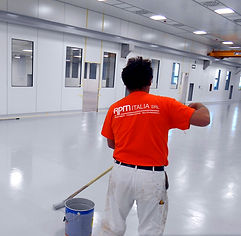
Based on the required performance, the installation of the resin floor is carried out following specific cycles. We calibrate thicknesses, finishes, and slip resistance to achieve a continuous, safe, and durable surface.
4)

Final inspection and commissioning
Once the hardening cycle is complete, and thus the catalysis of the product, the surface is ready to be used. At the end of the application, the floor is checked in every detail to ensure safety, continuity, and compliance with the project.
5)
Certifications and technical documentation
6)
At the end of the work, RPM Italia provides the client with the technical documentation related to the applied system, including the certifications required for each sector, to support the needs for monitoring and managing the flooring over time.

Alcune realizzazioni in resina di RPM Italia
Scorri la gallery e scopri alcune esempi di realizzazioni di RPM Italia.


