
Thickness from 0,05 mm to 1 cm
Epoxy Resin Flooring
The ideal solution for those seeking a continuous, durable, slip-resistant, and professional floor for industrial, commercial, and production environments.
The solidity
Epoxy flooring constitutes a technical system that increases the robustness of the surface and improves its functionality.
1
Uniformity
An extremely durable, compact, and joint-free coating: epoxy resin results in uniformity and/or continuity.
2
Flexibility
Applicable on concrete, but also on tiles and existing supports, with strong adhesion, the result is a single body with the substrate.
3
What is Epoxy Resin and how does it work
Epoxy resin is a two-component material that, once mixed and applied, creates an extremely durable, compact, and joint-free coating. Unlike a simple protective layer, epoxy flooring constitutes a true technical system, designed to enhance the robustness of the surface while simultaneously improving aesthetics, hygiene, and functionality.
When applied to concrete, tiles, or other existing substrates, the epoxy resin adheres tenaciously to the surface and forms a single body with the substrate. The result is a uniform, solid, and stable floor capable of supporting heavy weights, continuous stress, and demanding usage conditions.
Request information or a quote
RPM Italia creates epoxy resin flooring designed to meet the specific needs of each sector. Contact us for a site visit or technical consultation.
The difference between epoxy resin, dustproof, and polyurethane.
Epoxy resin is a structured coating designed to create continuous, durable, and high-performance flooring. It is applied with a greater thickness than surface treatments and is suitable for environments subject to heavy traffic, mechanical wear, and contact with chemicals.
Dust-proof resin represents a lighter solution, designed to consolidate and protect concrete without significantly altering its structure or thickness. It is ideal when the main goal is to block dust, improve cleanliness, and maintain the natural aesthetics of the substrate.
Polyurethane resin (or Poliuretano Cemento) stands out for its elasticity and high resistance to thermal shocks, humidity, and UV rays, making it particularly suitable for food environments or those subject to significant temperature variations.
Epoxy resin is therefore positioned as the ideal solution when solidity, hygiene, and durability over time are required.
Practical differences
The dustproof resin
The ideal solution to protect and consolidate concrete without altering its structure and thickness. Perfect for eliminating dust and improving the cleanliness of surfaces.
Polyurethane resin
Elastic, resistant to thermal shocks and stable to UV rays, polyurethane resin is suitable for food environments and areas subject to heat, cold, and humidity.
Why choose an epoxy resin floor
Epoxy resin is the preferred choice in the industrial sector for its combination of strength, durability, and ease of maintenance. This type of flooring ensures high tolerance to the passage of forklifts, pallet trucks, machinery, and heavy loads, making it perfect across many sectors, including manufacturing, logistics, public construction, and many others.
In addition to its robustness, epoxy resin flooring offers significant protection against liquids, oils, chemicals, and external agents that typically damage concrete and other substrates. The coating indeed creates a waterproof and seamless surface that prevents the substrate from absorbing dirt and moisture. Cleaning becomes much simpler and faster, a decisive advantage in environments where order and hygiene are essential.
From an aesthetic point of view, epoxy resin allows for a modern and tidy finish, customizable in various colors and appearances. This flexibility makes it suitable for commercial spaces, showrooms, and contexts where corporate image is an important element.
A floor suitable for multiple contexts
Epoxy resin is used in numerous sectors due to its versatility. It is particularly widespread in the manufacturing industries, where it withstands heavy traffic and wear from production processes. It is equally valued in the logistics and warehouse, where the surface must endure continuous movement of vehicles and goods.
In the food, pharmaceutical, and educational sectors, epoxy resin ensures high hygiene standards due to the absence of joints where dirt and bacteria can accumulate. Laboratories, workshops, mechanical processing, and chemical environments also require safe and resistant flooring against aggressive agents, characteristics that this resin fully meets.
RPM by Fibrokim has applied epoxy resin in the commercial sector as well, such as stores, showrooms, and exhibition spaces, where a uniform and well-finished floor contributes to the aesthetic value of the environment.
How an epoxy resin floor is made
The installation requires careful preparation of the substrate, a fundamental phase to ensure a lasting result. The substrate must absolutely not be wet or have rising moisture. In such cases, a vapor barrier or a three-component product must be applied. After analyzing the concrete, one proceeds with sanding, grinding, shot blasting, or milling of the existing surface (the mechanical abrasion is chosen based on the condition of the substrate, from new to very deteriorated) in order to eliminate inconsistent parts and create the correct roughness for adhesion. Following this is the application of the primer, which consolidates the substrate and promotes the anchoring of the resin.
Subsequently, the actual epoxy cycle is applied, which can be smooth or have customized finishes depending on the needs of the environment. The final result is a stable, resistant, and perfectly continuous coating.
Preliminary analysis of the environment
Every project starts with a technical inspection during which the existing support, environmental conditions, and usage methods of the floor are analyzed to identify the most suitable resin system and to prevent future issues.
1)

Preparation of the substrate
Targeted mechanical processing, such as sanding, grinding, and shot blasting, is carried out to prepare the concrete substrate, or other types, essential to ensure the adhesion of the resin cycle and the durability of the flooring.
2)

Execution of complementary works
Before or during the installation of the resin floor, complementary works are carried out, namely drainage supports, perimeter edges, and skirting boards. These elements help complete the environment and facilitate cleaning and sanitization.
3)
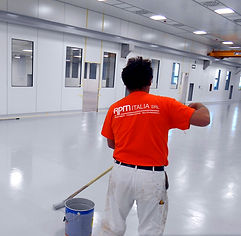
Application of the resin cycle
Based on the required performance, the installation of the resin floor is carried out following specific cycles. We calibrate thicknesses, finishes, and slip resistance to achieve a continuous, safe, and durable surface.
4)

Final inspection and commissioning
Once the hardening cycle is complete, and thus the catalysis of the product, the surface is ready to be used. At the end of the application, the floor is checked in every detail to ensure safety, continuity, and compliance with the project.
5)
Certifications and technical documentation
6)
At the end of the work, RPM Italia provides the client with the technical documentation related to the applied system, including the certifications required for each sector, to support the needs for monitoring and managing the flooring over time.

Alcune realizzazioni in resina di RPM Italia
Scorri la gallery e scopri alcune esempi di realizzazioni di RPM Italia.


