
Thickness 3 – 9 mm
Flooring in Poliuretano Cemento
The Poliuretano Cemento is a high-performance continuous flooring that combines the flexibility of polyurethane with the strength of cement.
Robustness
The cementitious component gives the floor a compact and solid structure, capable of withstanding impacts, heavy traffic, and mechanical stresses.
1
Resistance
The Poliuretano Cemento guarantees a high tolerance to aggressive substances, oils, fats, and industrial detergents, as well as excellent resistance to thermal shocks.
2
Hygiene
The continuous, waterproof, and joint-free surface reduces the risk of contamination, making it compliant with the strictest hygiene standards.
3
What is Poliuretano Cemento and what are its characteristics?
The Poliuretano Cemento is a multi-component flooring system that combines polyurethane resins, cementitious binders, and mineral aggregates. This formulation creates a continuous coating with high thickness, extremely resistant and stable, capable of working in synergy with the concrete support.
Unlike more elastic resins, Poliuretano Cemento offers a greater structural mass, making it particularly suitable for environments subject to high loads, sudden thermal shocks, and frequent chemical stresses.
The presence of cement also improves breathability and compatibility with industrial substrates, reducing the risk of detachment over time.
Request a site visit or a quote
RPM Italy creates flooring in Poliuretano Cemento tailored for industrial, food, and professional environments. Contact us to receive a personalized technical consultation or to schedule a direct inspection with our specialists.
Practical differences
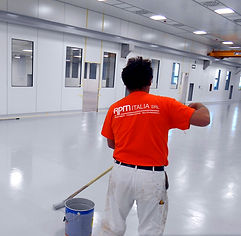
Pavimento in poliuretano cemento realizzato da RPM Italia
Why choose a floor in Poliuretano Cemento
The Poliuretano Cemento flooring is chosen when operating conditions are particularly severe. One of its main features is the resistance to thermal shocks, which allows it to withstand sudden changes from hot to cold without cracking or degrading.
This flooring is also ideal in the presence of:
frequent washing with hot water or steam
continuous contact with aggressive chemicals
intense traffic from trolleys, forklifts, and machinery
The Poliuretano Cemento maintains high performance even in humid and wet environments, ensuring a non-slip, safe, and easily sanitizable surface. All fundamental elements in sectors where hygiene is not an option, but a regulatory requirement.
Where is Poliuretano Cemento used?
The Poliuretano Cemento finds its ideal application in high-criticality industrial contexts.
It is particularly widespread in the food sector, where it is used in: processing industries; industrial kitchens; slaughterhouses; dairies; breweries and bottling plants.
Thanks to its thermal and chemical resistance, it is also highly valued in the pharmaceutical, chemical and cosmetic industry, where floors are subjected to aggressive washing and stringent hygiene controls.
It is also used in heavy production environments, such as industrial plants, processing areas and technical rooms, where durability, safety and operational continuity are required.
The application process of the system in Poliuretano Cemento
The application of Poliuretano Cemento requires careful evaluation of the existing substrate. The concrete base is analyzed and prepared through grinding, shot blasting, or scarification, in order to achieve the correct porosity and ensure optimal adhesion. After applying the specific primer, the installation of the Poliuretano Cemento system proceeds, calibrating thicknesses and finishes according to the needs of the environment. The application cycle is designed to create a monolithic surface, resistant and engineered to maintain its characteristics even in extreme operating conditions.
Preliminary analysis of the environment
Every project starts with a technical inspection during which the existing support, environmental conditions, and usage methods of the floor are analyzed to identify the most suitable resin system and to prevent future issues.
1)

Preparation of the substrate
Targeted mechanical processing, such as sanding, grinding, and shot blasting, is carried out to prepare the concrete substrate, or other types, essential to ensure the adhesion of the resin cycle and the durability of the flooring.
2)

Execution of complementary works
Before or during the installation of the resin floor, complementary works are carried out, namely drainage supports, perimeter edges, and skirting boards. These elements help complete the environment and facilitate cleaning and sanitization.
3)
Application of the resin cycle
Based on the required performance, the installation of the resin floor is carried out following specific cycles. We calibrate thicknesses, finishes, and slip resistance to achieve a continuous, safe, and durable surface.
4)

Final inspection and commissioning
Once the hardening cycle is complete, and thus the catalysis of the product, the surface is ready to be used. At the end of the application, the floor is checked in every detail to ensure safety, continuity, and compliance with the project.
5)
Certifications and technical documentation
6)
At the end of the work, RPM Italia provides the client with the technical documentation related to the applied system, including the certifications required for each sector, to support the needs for monitoring and managing the flooring over time.

Alcune realizzazioni di RPM Italia
Scorri la gallery e scopri alcune esempi di realizzazioni di RPM Italia.


